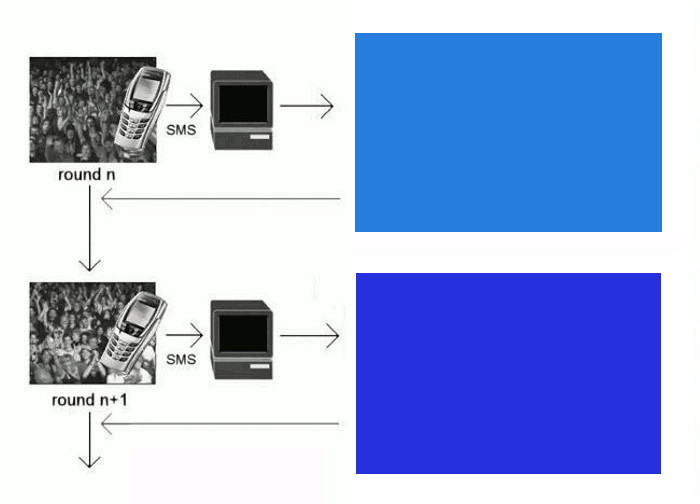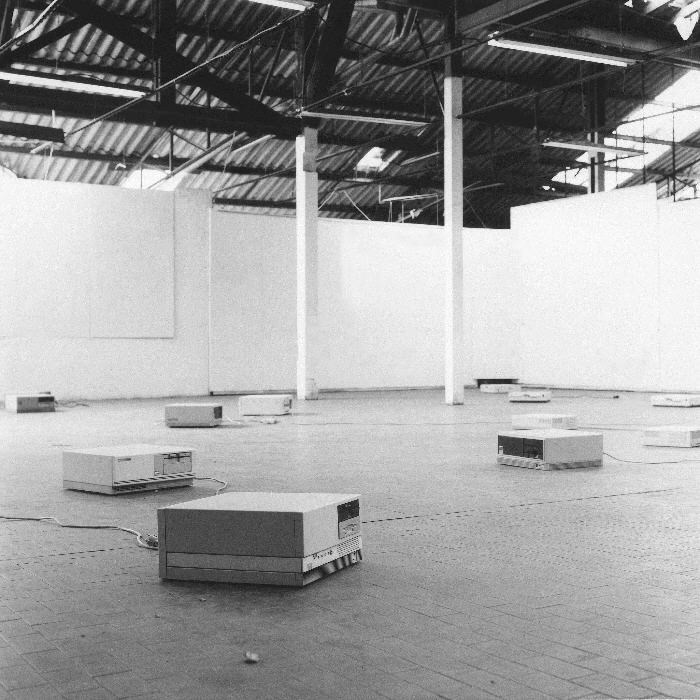
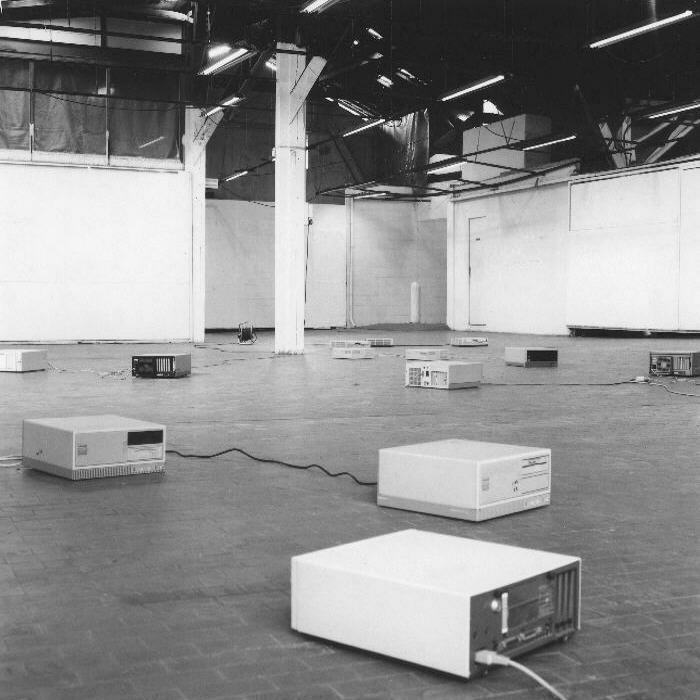
Programmed Machines (Sealed Computers), Nice, France, 1992-97
| maurizio bolognini | |bio (600 words) bio (300 words) intro index| |
Programmed Machines (Sealed Computers), Nice, France, 1992-97
|
→en Maurizio Bolognini, artista e ricercatore, lavora all'intersezione tra arte e tecnologia. Le sue installazioni esplorano le implicazioni estetiche e sociali dei nuovi media, indagandone dimensioni diverse: la possibilità di delegare l'azione artistica al tempo infinito della macchina, la generazione di infinità fuori controllo (immagini sconfinate, come nelle serie Computer sigillati e Macchine programmate, dal 1988), l'introduzione di forme avanzate di interattività (serie SMS Mediated Sublime, 2000, e ICB-Interactive Collective Blue, 2006), il networking e l'e-democracy, i flussi spazio-temporali della comunicazione tecnologica e le interferenze tra spazio geografico e spazio elettronico (serie Altavista, 1996, Antipodes, 1997, Museophagia, 1998-99).Prima di dedicarsi alla ricerca artistica ha studiato Urbanistica all'Università IUAV di Venezia e Scienze sociali alla Birmingham University (UK), e ha lavorato come ricercatore nell'ambito della democrazia elettronica e delle tecniche di comunicazione di rete (che ha usato più tardi anche in alcuni lavori interattivi). Le sue prime installazioni esplorano le nozioni di spazio e tempo attraverso l'attivazione, minima e astratta, di processi tecnologici incontrollati, all'incrocio tra arte concettuale e arte generativa, e più tardi, arte pubblica e democrazia elettronica. Nel 1988 inizia a usare personal computer per produrre flussi inesauribili di immagini casuali (serie delle Macchine programmate, esposte ampiamente). Negli anni '90 programma centinaia di computer che generano immagini in continua espansione (serie IMs e Atlas 2). Nel 1992 comincia a sigillare le sue macchine, lasciandole funzionare all'infinito ma senza possibilità di connessione a uno schermo (serie Computer sigillati). Dal 2000 il suo lavoro si concentra sulla combinazione di dispositivi di programmazione e di democrazia elettronica, come in SMS Mediated Sublime, Collective Intelligence Machines e Interactive Collective Blue, installazioni interattive che connettono alcune delle Macchine programmate alla rete telefonica cellulare, consentendo l'intervento del pubblico. I suoi lavori sono stati esposti in numerose occasioni, in Europa e negli Stati Uniti. Tra le mostre personali: PAN, Palazzo delle Arti, Napoli; Museo di Arte Contemporanea di Villa Croce, Genova; Museo Laboratorio di Arte Contemporanea, Roma; Istituto Italiano di Cultura, Parigi; Cavellini, Brescia; Morra, Napoli; Neon, Bologna; Centro di Arte Contemporanea Ticino, Svizzera; Williamsburg Art and Historical Center, New York; Palazzo Ducale, Genova; Galerie Depardieu, Nice; Roger Smith Lab, New York. Tra le mostre collettive: Macro, Museo di Arte Contemporanea, Roma ("ADD2011"); Museo Laboratorio di Arte Contemporanea, Roma ("Art@network"); Museo di Arte Contemporanea di Villa Croce, Genova ("Il viaggio dell'uomo immobile"); Taipei Museum of Fine Arts (9th Biennial of Drawing), Taipei; Kunsthaus Langenberg, Germania ("Tuhfulung"); Art Palace, Cairo ("Imafy"); Museo del Sannio, Benevento ("New Technologies: Ascott, Bolognini, Forest, Kriesche, Mitropoulos"); Housatonic Museum of Art, Bridgeport CT ("It's For You. Conceptual Art and the Telephone"); Museo Mambo, Bologna ("No Neon No Cry"); Museo Gamec, Bergamo ("Salto nel Vuoto"). Lectures e presentazioni delle opere comprendono tutte le Artmedia Conferences dal 1995 al 2009, in particolare alla École Normale Supérieure (ENS) e all'Institut National d'Histoire de l'Art (INHA), Parigi. Inoltre MLAC, Università "La Sapienza" di Roma; Generative Art Conference, Politecnico di Milano; WSE Meeting, University of Shiga, Giappone; International Media Art Forum for Youth, Cairo. E' autore di diverse pubblicazioni tra cui Democrazia elettronica (Carocci, Roma 2001), Postdigitale (Carocci, Roma 2008), Machines (Postmedia Books, Milano 2012), Schermologie 1990-2017 (YCP, Tricase, Le, 2018). Il lavoro di Bolognini è documentato sia da pubblicazioni di arte contemporanea (Flash Art, Tema Celeste, Arte e Critica, Luxflux, Artpress, Ligeia, New York Art World, NY Arts Magazine, PerformArts, tra le altre) sia da diversi libri e cataloghi, tra cui: S. Solimano (a cura di), Maurizio Bolognini: Programmed Machines 1990-2005 (Museo di Arte Contemporanea di Villa Croce, Genova 2005); S. Solimano et al., Infinito personale (Nuovi Strumenti, Brescia 2007); D. Scudero (a cura di), Maurizio Bolognini. Installazioni, disegni, azioni (Lithos, Roma 2003).   Programmed Machines (Sealed Computers), Gamec (Leap into the Void), 2023 |
|
→ita
|